- Fish health checked before every dispatch
- Stocking advice with every order
- You speak to the people who raise the fish
- Delivering to Dullstroom
The trout life cycle in one minute
At Stillriver Trout every fish we sell has been through the same stages: eyed ova, alevin, fry, fingerling and table fish. A breeding fish lays eggs, the eggs develop eyes, hatch into alevins that live off a yolk sac, swim up as fry and start feeding, grow into fingerlings and then into table fish. A few are kept back to become the next generation of breeders.
The stages are fixed. The timing is not. Trout cannot control their own body temperature, so water temperature sets the pace of everything, from how long an egg takes to hatch to how fast a fingerling grows. In cold water every stage stretches out, and in water that is too warm, trout stop eating altogether.
This guide goes through each stage, how long it takes and what the fish needs.
The stages of the trout life cycle
Durations below come from published figures for rainbow trout unless a stage says otherwise. Grow-out times assume water of 5 to 15 °C and good commercial feed.
-
Eggs and eyed ova
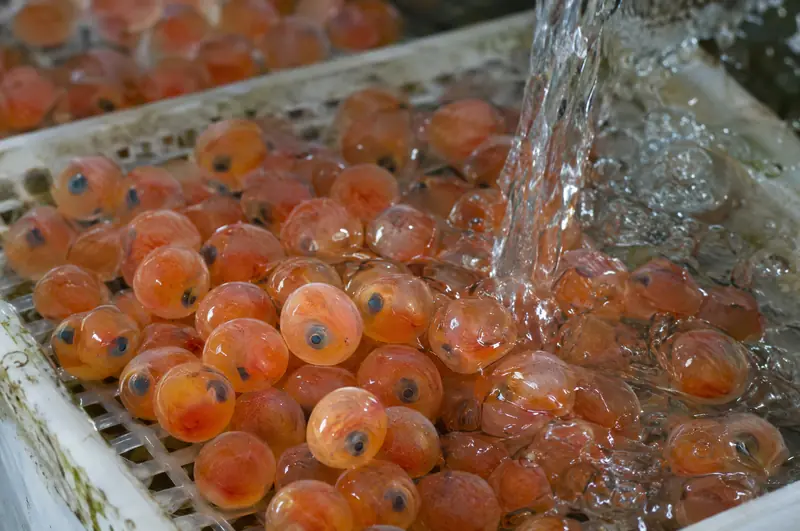
Rainbow trout eggs are 3 to 7 mm across, and a female can produce up to 2,000 eggs per kilogram of her body weight. After fertilisation, the egg develops until the eyes show as two dark spots through the shell. At that point it is called an eyed egg, or eyed ovum. That is the stage at which hatcheries buy and sell eyed trout ova.
Hatching time depends on temperature: about 100 days at 3.9 °C and about 21 days at 14.4 °C, roughly 370 degree-days in total. Eggs and fry need water with a pH of 6.5 to 8 and at least about 5 to 6 mg of oxygen per litre.
-
Alevin
A newly hatched trout is an alevin, or sac fry. It carries a yolk sac on its belly and lives off it for about 2 to 4 weeks. For brown trout, the yolk-sac period from hatching to first feeding is about 38 days at 7.5 °C. From fertilised egg to swim-up, rainbow trout development takes about 37 to 83 days at 6 to 12 °C.
-
Fry
When the yolk is nearly gone, the alevin swims up and starts to feed. This is the most demanding stage on a hatchery. Starter feeding runs at about 10% of body weight a day for 2 to 3 weeks, on starter pellets of about 50% protein. One hatchery programme feeds swim-up fry 6 to 10 times a day for about 8 to 10 weeks. Growing from swim-up to a fry of about 5 cm and 2 g takes 1.5 to 3 months.
-
Fingerling
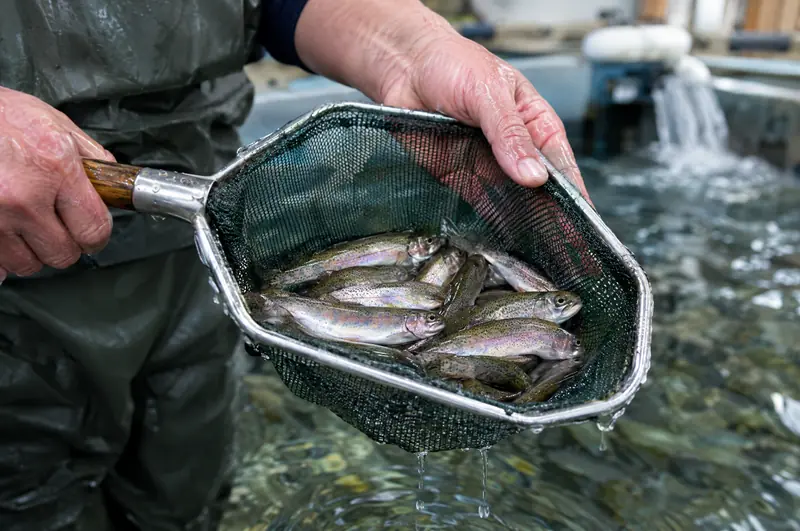
From fry, the fish grows to a fingerling of about 12.5 cm and 25 g in 3 to 4.5 months. Young fish are usually moved to outdoor grow-out at 8 to 10 cm, around 250 fish per kilogram. This is the stage most often sold for stocking dams and fishing venues: past the delicate early weeks, small enough to transport in numbers, and ready to grow on in open water.
-
Table fish
From fingerling to a table fish of at least 250 g takes 4 to 6.5 months. Growing on from 250 g to 500 g takes a further 2.5 to 4.5 months. Fish usually reach a marketable 30 to 40 cm within about 9 months, and pan-sized fish of 280 to 400 g are harvested after 12 to 18 months. What counts as table size varies by market: about 450 to 600 g in the USA, and 1 to 2 kg in Europe.
-
Breeding adults
Rainbow trout mature at about 3 to 4 years. On a hatchery, a small group of broodstock is kept for breeding, and their eggs start the cycle again.
Why temperature sets the pace
In the egg, development runs on degree-days: the colder the water, the more days it takes. That is how the same rainbow trout egg can take about 100 days to hatch in near-freezing water and about 21 days in cool water.
After hatching, temperature controls appetite and growth. Rainbow trout feed best at about 7 to 18 °C, and the best growth from feed comes at 13 to 15 °C. Above about 18 °C, appetite falls sharply and then stops. Brown trout grow between about 3.5 and 19.5 °C, with maximum growth at 13 °C.
Brown trout eggs also run on a different clock. In one hatchery programme at 10 °C, rainbow trout eggs hatched in about 31 days and brown trout eggs in about 41. Brown trout eggs survive in water of about 0 to 13 °C.
The stage times on this page are published ranges, not promises. A hatchery in colder water will sit at the slow end; one with water close to the growth optimum, and well fed, will sit nearer the fast end. Warm summer water can stall growth completely.
What can go wrong at each stage
Each stage has its own weak point. Knowing them explains why hatcheries work the way they do, and why some stages cost more to buy than others.
Risks for eggs and alevins
The early stages need the cleanest water on the farm. The pH band for eggs and fry is narrow, 6.5 to 8, compared with 6.5 to 8.5 for older fish, and the minimum oxygen is higher, about 5 to 6 mg per litre against about 4 to 5 mg per litre later on. Continuous low oxygen at this age can cause malformations in young fish.
Risks for fry
First feeding is the bottleneck. Fry need small, frequent meals of high-protein starter feed, and overfeeding fouls the water quickly because uneaten feed rots and uses up oxygen. Mouldy feed will kill trout at any age.
Risks for fingerlings
The big risk is the move. Fingerlings going out to a dam or a venue face a new temperature, new water and often warmer conditions. Temperature shock at stocking is one of the most overlooked causes of losses, so fish should be brought slowly to the temperature of the new water before release.
Risks for table fish
Larger fish use more oxygen and are more exposed to summer heat. Water above about 21 °C for more than a few hours can be lethal to rainbow trout, and in South African trout farming the worst losses come in late summer, in February and March, when warm water combines with poor water quality.
What the life cycle means if you are buying trout
For dam owners
Fingerlings are the usual choice. They have survived the delicate early stages and can grow on in open water, as long as the water stays cool and well oxygenated. Read why trout die in dams before you stock, and plan to stock trout fingerlings once your dam has cooled in autumn.
For hatcheries
Eyed ova let you skip keeping broodstock and the earliest days after fertilisation. You still need clean, cold water, a narrow pH band and good oxygen through incubation and swim-up.
For new farmers
The life cycle is also your cash-flow timeline. Pan-sized fish are usually harvested after 12 to 18 months, with feed, power and labour to pay throughout. Our trout farm setup service plans around it, and fish farming training shows each stage on a working farm.
Questions about the trout life cycle
How long does it take trout eggs to hatch?
It depends on water temperature. Rainbow trout eggs take about 100 days to hatch at 3.9 °C and about 21 days at 14.4 °C. One hatchery programme reports about 31 days at 10 °C for rainbow trout and about 41 days for brown trout. Colder water means a longer wait, which is why hatcheries track temperature every day.
What is an alevin?
An alevin is a newly hatched trout that still carries its yolk sac, a bag of food attached to its belly. It stays low in the gravel or the hatchery tray and lives off the yolk for about 2 to 4 weeks. Once the yolk is nearly used up, it swims up to start feeding, and from then on it is called a fry.
What is the difference between fry and fingerlings?
Fry are the young fish that have just started eating, up to about 5 cm and 2 g. Fingerlings are the next stage, growing to about 12.5 cm and 25 g. Fingerlings are the size most often used for stocking dams and fishing venues, because they are past the most delicate stage and ready for life outdoors.
How long does a trout take to reach table size?
On a farm with good commercial feed at 5 to 15 °C, published stage times add up to many months from swim-up to a table fish of at least 250 g. Pan-sized fish of 280 to 400 g are usually harvested after 12 to 18 months. Larger fish take longer: going from 250 g to 500 g adds about 2.5 to 4.5 months.
At what age do trout breed?
Rainbow trout mature at about 3 to 4 years old. A female can produce up to 2,000 eggs per kilogram of her body weight. On a hatchery, broodstock are kept for breeding and their eggs are fertilised and incubated in controlled conditions, which is where the life cycle starts again.
Do brown trout and rainbow trout have the same life cycle?
They pass through the same stages, but the timing differs. At 10 °C, brown trout eggs take longer to hatch than rainbow trout eggs: about 41 days against about 31 in one hatchery programme. Brown trout and Atlantic salmon eggs take about 100 days at 5 °C and 50 days at 10 °C, and brown trout eggs survive in water of about 0 to 13 °C.